Building Capability That Sustains: Case Studies from Niiti’s Doer’s Labs Practice

Updated: Mar 9
Across sectors, traditional training programmes struggle to translate learning into sustained behaviour change. Research on training transfer suggests that only a small proportion of learning is applied in real work settings, with estimates indicating that less than 20% of training translates into on-the-job practice.
Organisations continue to face challenges with adoption, retention, and application despite significant investments in capacity building. Niiti works at the intersection of learning design, organisational behaviour, and implementation realities. Rather than delivering standalone trainings, we build learning systems that enable people to apply, adapt, and sustain change within real operational constraints.
This approach emerged from Niiti’s early work in 2015, when many Internal Committees (ICs) formed under the PoSH Act (2013) existed largely in structure. The volunteers appointed to these ICs often did not have the required skills or clarity to conduct thorough inquiries. The insight was clear: compliance structures alone do not create impact — practitioners need opportunities to learn by doing.
The Doer’s Lab emerged in response to this gap as a practice-centred learning model designed to build confidence, judgement, and applied capability through real-world simulation, reflection, and guided practice, be it for karigars in Lucknow, mid-level corporate managers or even microentrepreurs in remote rural hamlets. Since then, the Doer’s Lab has informed Niiti’s broader approach to capacity building across sectors, grounding learning in action rather than instruction.
Niiti’s Signature Approach to Capacity Building
We look at capacity building as a process of enabling practice change. Instead of measuring participation or training course completion, we focus on observable shifts — how individuals make decisions differently, how organisations use evidence, and how learning continues beyond the intervention itself.

Diagnosing real capability gaps and specific training needs
Framing and defining intended observable outcomes linked to organisational goals
Understand the operational realities, constraints and leverage points
Co-designing learner-centred intervention, using constraints as design inputs
Embed continuous feedback loops
Adapt content and delivery iteratively
Facilitate reflection and applied learning
Establish peer learning ecosystems for learning sustainability
Design Features of Niiti’s Capacity Development Approach
Niiti’s capacity development programmes are grounded in adult learning principles and emphasise application through practice. Learning designs respond to learner constraints, using visual and gamified elements to break complex processes into accessible, memorable steps. Content is developed in English and delivered in local languages to ensure relevance and ownership. Through multi-modal pedagogy — combining text, audio-visual content, discussion, and hands-on practice — Niiti strengthens engagement and retention.

Role-play enables embodied learning by allowing participants to test decisions in realistic scenarios. Practical tools such as SOPs, templates, and reference materials provide scaffolding for independent continuation beyond the programme. Peer groups and WhatsApp communities further sustain reinforcement and problem-solving over time, gradually transitioning ownership to the learning community.
Types of Capacity Building solutions Niiti has worked on
Over the past 10 years, Niiti has designed capacity strengthening interventions across sectors and at multiple levels starting from the individual practitioners and entrepreneurs level, moving on to strengthening MEL capabilities within non-profits; and towards building organisation-wide learning systems that support onboarding, adaptation, and growth at scale.
At an Individual Level, Niiit facilitates applied, contextual learning such as basic business understanding and how to run a simple home-based nano enterprise.
At an organization level, Niiti designs and co-creates a suitable Learning systems & culture aligned with the organization’s philosophy and goals, such as L&D platform of an Agri-tech startup on aligning diverse staff spread across geographies with the organization’s vision and goals.
At an ecosystem level, Niiti’s enables diverse actors across the system to converge on shared points and build collective capability such as through an outcome mapping workshop for a cohort of grassroots NPOs.
Case studies
The following case studies illustrate how this approach translates across diverse contexts — from grassroots livelihoods and nonprofit learning ecosystems to large organisational systems. The idea is to showcase how an outcome-focussed learning design can shift behaviours in the short and long term.
Case 1: Practitioner-Centered Capacity Building — Grassroots Tea Corporation (GTC)

Context
Grassroots Tea Corporation (GTC) works with small tea growers across Assam to strengthen value creation and entrepreneurship within tea-growing communities. GTC engaged Niiti to build the capacities of rural women and producer company leaders to establish and manage home-based tea processing units and operate tea producer companies as viable business enterprises.
Challenge
Home-based tea processing had limited professional reference models, and participants had little access to operational knowledge. Training needed to translate complex technical and business concepts into practical, locally relevant understanding for first-generation entrepreneurs while building confidence to independently train others.
Niiti’s Practitioner-Oriented Design
Niiti began with extensive field immersion, visiting households and engaging ecosystem actors including tea experts, manufacturers, buyers, and government stakeholders. Training content and financial planning tools were co-developed and iteratively refined based on feedback. Materials were delivered in English and Assamese using visual, audio, and written formats. Sessions emphasised interactive participation, practical decision-making, and follow-up support through a WhatsApp group to address emerging challenges.
Observable shift:
Participants moved from trainees to local resource persons, independently conducting village-level trainings, forming collectives to establish processing units, and initiating shared financial investments.
Producer company leaders demonstrated stronger operational clarity, approaching tea processing not as an activity but as a viable enterprise. Capacity building translated into ownership and collective action, grounded in locally relevant practice and sustained peer support.
Case 2: Practitioner-Centred Capacity Building — Project Utthan (Life Skills Training for Karigars)
Context
Project Utthan, a multi-brand initiative involving global luxury fashion brands including Kering, LVMH, and Burberry, aimed to improve the well-being and resilience of embroidery artisans (karigars) working within export houses in Mumbai. Niiti Consulting was engaged to design and implement a life-skills training programme focused on strengthening artisans’ financial literacy, health awareness, digital use, and interpersonal capabilities to better navigate everyday work and life realities.
Challenge
Karigars operated under significant constraints — low literacy levels, production-driven factory environments, limited access to formal financial systems, and minimal exposure to structured learning beyond technical craft skills. Conventional classroom training models were not viable within noisy factory settings, tight schedules and varying attention spans. The programme demanded translating abstract concepts into practical, readily usable knowledge while maintaining dignity, engagement and relevance for urban migrant karigars.
Niiti’s Practitioner-Oriented Design
Niiti grounded the intervention in a diagnostic study of artisans’ lived realities, examining financial behaviours, health practices, migration patterns, and workplace dynamics beyond factory hours. Rather than adapting standard training formats, programme design treated existing constraints — low literacy levels, production pressures, limited time, and noisy factory environments — as core design inputs.
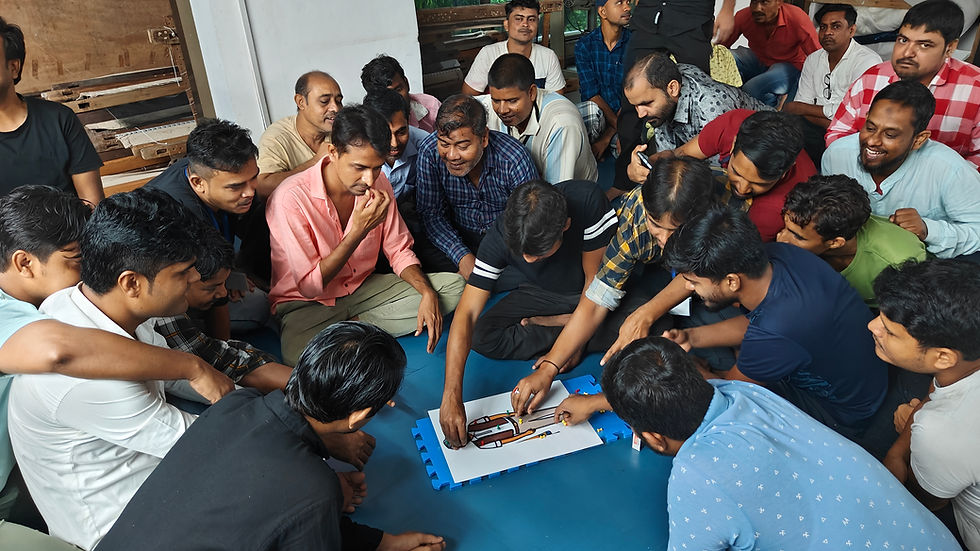
Learning was therefore structured to be experiential, visual, and practice-oriented, using games, role-play, peer discussion, and facilitated reflection instead of lecture-based instruction. Content was simplified without dilution, anchored in everyday decisions artisans regularly faced. Sessions followed a cycle of pre-exposure, interactive in-person learning, and post-session reinforcement through videos, visual aids, local champions, and WhatsApp-based follow-ups. Continuous feedback from participants and factory partners informed iterative refinements, ensuring the programme remained responsive to learner needs and operational realities.
Observable shift:
Karigars began applying financial concepts in daily life, adopting regular savings practices and demonstrating greater confidence in navigating formal financial systems independently.
Participants increasingly used digital and public service platforms, including banking and government access systems, signaling movement from dependence toward self-directed access.
Participants reported improved empathetic communication and reduced interpersonal friction
Case 3: MEL Capacity Building for Non-profits — Oak Foundation Grantees
Context
Oak Foundation supported a diverse set of non-profit grantees working across thematic areas in India. While organisations were collecting data and reporting progress, there was a need to strengthen their ability to use monitoring, evaluation, and learning (MEL) processes for reflection, decision-making, and programme improvement rather than compliance reporting.
Challenge
Grantees operated at different levels of MEL maturity, often tracking numerous indicators without clarity on relevance or use. Learning remained siloed within organisations, and data was not consistently translated into programme insights or shared reflection. Building a shared evaluation and learning culture required both technical strengthening and behavioural shifts in how organisations engaged with evidence.
Niiti’s Practitioner-Oriented Design
Niiti designed a multi-year capacity building framework focused on Theory of Change development, prioritisation of indicators, qualitative approaches such as Most Significant Change and Outcome Harvesting, data interpretation, and formulation of learning questions. The approach embedded reflection events, peer-led learning sessions, and shared learning platforms, including online repositories and group communication channels, enabling continuous exchange beyond formal trainings.
Observable shift:
Organisations began using data as a tool for reflection and decision-making rather than reporting alone.
Grantees streamlined monitoring systems to focus on fewer, more meaningful indicators and increasingly analysed disaggregated outcome data to generate programme insights.
Evidence practices shifted from compliance-driven tracking toward shared organisational learning.
Case 4: Building an Organisational Learning Culture — DeHaat Academy
Context
DeHaat, a rapidly growing agri-tech company operating across multiple geographies, needed a scalable way to onboard and continuously train a young and expanding workforce. Employees required specialised knowledge combining agriculture and technology, adapted to diverse regional contexts.
Challenge
Training needed to be practical, uniform, and cost-effective while remaining relevant to local farming realities. Traditional one-time trainings could not keep pace with organisational growth, evolving field conditions, and the need to retain skilled employees through continuous learning opportunities.
Niiti’s Practioner-Oriented Design
Niiti partnered with DeHaat to conceptualise and build DeHaat Academy — an organisational learning platform integrating onboarding, self-paced upskilling, and continuous learning with real-time feedback. The design embedded learning at multiple levels: individual, team, organisational, and external environment. The platform was piloted across three states, iteratively refined, integrated with the HR management system, and supported through webinars, trained facilitators, incentives, and self-enrolment pathways.
Observable shift:
Learning evolved from periodic training events into an embedded organisational system supporting continuous skill development, onboarding, and knowledge sharing at scale.
Following organisation-wide rollout, 60% of employees actively accessed learning content, averaging approximately 260 minutes of learning engagement per month, indicating sustained adoption rather than one-time participation.
Webinars and facilitated sessions generated over 3,000 learning touchpoints, enabling consistent onboarding and peer learning across dispersed geographies.
The Academy positioned learning as an ongoing organisational function — aligned with employee growth, operational performance, and the company’s rapid scale-up needs.
Conclusion
Niiti’s design-led approach, shaped by participant realities, constraints, and continuous feedback, enables learning to move beyond training into sustained practice. By adapting methods while holding a consistent philosophy, Niiti supports individuals and organisations to apply, internalise, and carry forward learning independently. Capacity building thus becomes a pathway to lasting capability, not a one-time intervention.


Comments